Browns Bay
The first European owner of land at Browns Bay was John Logan Campbell who, in 1864, received a deed for allotment # 189 in the Parish of Takapuna for "his good services to the colony " - signed by Sir George Grey. This allotment included the land from the south end of Browns Bay north to Okura. Campbell believed there was coal in the area, but exploratory mineshafts dug into the cliff faces above the high tide level between Browns Bay and Waieke were unrewarding, so he had the land subdivided for farming.
A Mrs Hammond was the first owner of the 136 acre block including the beach and flat land of what became Browns Bay. She built a small house but sold to Mr Peter Brown in 1876.
Peter and Mary Brown with their children were living in Auckland, and on September 26 1876 the family with furniture and wagon sailed in a cutter to Browns Bay while Mr Brown rode on horseback via Devonport. The cutter was unloaded and the horse and wagon used to get the family's belongings to what is now the corner of Anzac and Clyde Roads.
The area needed a lot of work to be cleared of tea tree, flax, scrub, and poisonous tutu. The beachfront was covered by high sandunes. Shelter from the wind was required so trees were planted along the beach. With a lot of hard work the land was cleared and improved in due course cattle were grazing and an apiary, orchard, and vineyard were established.
Below - looking down Browns Bay road towards the sea. R-Alexander Brown with his horse and gig. L-the Brown homestead.

The nearest store for provisions was in Devonport, there were no roads whatsoever, while the postal address was Lucas Creek (now Albany).
At this time the Hauraki Gulf was still healthy and teeming with seafood. Maori had inhabited the coast in substantial numbers before the Musket Wars of the 1820's, and there was a small pa near the outlet of Tiaotea Creek.
Cart tracks and clay roads were constructed with pick and shovel - initially up to Pine Hill, and then to Wade Road (now East Coast Road). In the 1880s a seaside boarding house was built from the Browns' own trees, milled by Smith brothers at Deep Creek. The Brown family set up a small store and post office, selling food from their farm as well as fish caught at the beach.
A part time school was started in a small building on Hyde Road, around the same time as Deep Creek school opened in 1888, however by 1900 they were still only half a dozen families living permanently in the bay.
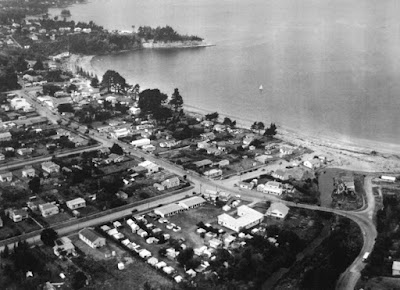
With with access provided by clay road as well as regular scheduled visits from Northern Steamship Company vessels, Browns Bay soon became a popular place for weekend summer camping, and the Browns opened a guest house beside their homestead. Fresh farm produce and seafood were served to guests. This area developed into a campground, which was very popular for many years. A supermarket was built on the site in late in the 20th Century, which is Countdown today.
Slow but steady improvement of the roads, and a wooden wharf built around the turn of the 20th Century, helped make Browns Bay and increasingly popular site. However clay roads were impassable in winter and at best a trip from Auckland still took all day.
Goods were delivered by cutter and it was the captains of this early vessels who named the bays along the coast (often after the owners of the land). A wooden wharf was constructed in Browns Bay around the turn of the century - located where the boat ramp and boating club/Coast Guard are today - and extended during the First World War.
Brown Bays' popularity was greatly accelerated after 1910, when a steam tramway was constructed - running from the Bayswater Ferry Terminal through Takapuna to Milford. However, it was still quite a trek from there on to Browns Bay either on horseback or walking around the beaches at low tide.
The next major event in the development of the bay came in 1916, when the Browns subdivided the land, offering sections from £100 each. At this time their two sons, Peter and Alexander, were on active duty in France. Shortly after, the Cryer family, who owned much of the other flat land in the bay, did likewise. By 1919 road- and beach-side batches were beginning to appear as the road network slowly grew. A Section-holders Association was formed in 1920. Despite all this activity, as late as 1932 there were only 11 permanent residences in the bay.
With holiday baches appearing in larger numbers, a second store was opened by Mrs Wilkinson in 1921 on Clyde Road. In 1922 Nyburg's store opened, and later the store owners offered transport by car or truck to and from Milford and the tramway. Transportation to the bays had improved in the 1930s when the North Shore transport company took over from private transport operators and began its public service to the bays from the Bayswater ferry terminal.
In 1936 there was a major storm which severely damaged the wharf to the extent that it was unable to be used. the structure was never repaired but demolished in 1939. This storm also destroyed the wharf at Torbay.
The 555 cabaret and cinema opened in 1925. This quickly became a centre of entertainment for yachties and holidaymakers (as well as other far less savoury characters and activities) and for a while the area was known as "naughty Bay". Brawls were frequent, and on one night five ambulances were required to assist the injured!
The 555 (pronounced Five-Fifty-Five) theatre was built by Nicholas Silich – very much an entrepreneur who was also an engine mechanic, welder, shed- and boat-builder. As the combined population of Browns Bay, Deep Creek and Long Bay was only around 1000 at the time there was extreme scepticism that this venture would succeed. The seating capacity of the hall was about 450. However, the enterprising Mr Silich was banking on attracting not only people from the local bays but also the increasing number of holidaymakers who flocked to the area during school holidays from the city. Even during the depression the cinema continued and even thrived, being packed out in summer. The seats were long deck chairs seating eight people each. These were easily folded up and stored away- leaving a large central space around 100 m x 100 m which could be used for dances which were also extremely popular.
However, further major expansion was limited by the economic difficulties of the depression and then events of World War II. Development did not recommence until the mid-1940's. With no ferry service Browns Bay was isolated from Auckland city. Roading improvements after the War, expansion of the military airforce bases at Hobsonville and Whenuapai, increasing affordability of motor cars and an influx of immigrants from Europe meant that housing, commercial and industrial development then picked-up considerably.
The opening of the Auckland Harbour Bridge on 30 May 1959 saw an end to the isolation of Browns Bay and the entire North Shore (and beyond).


Comments
Post a Comment