Castor Bay - WWll Gun Emplacements
Castor Bay Kennedy Park Military Installation: 63rd Battery RNZA

In early WWll Auckland port faced the imminent threat of German seapower: in June 1940, the German raider Orion had laid mines off the approaches to the Hauraki Gulf, resulting in the sinking of the liner Niagara. ln August Orion sank the Turakina in the Tasman Sea, then in November (in company with Komet) sank the liner Rangitane off the east coast of the North Island. Consequently local military and civil authorities were extremely alarmed, and took immediate action to defend approaches to the vulnerable harbour.
The battery at Castor Bay was constructed as part of the strengthening of Auckland’s coast defences. Access to the wartime entry to Auckland port was to be redirected through the Whangaparaoa Passage because the main sea access (the channel between Tiritiri Matangi Island and Motutapu lsland) was to be closed and protected by a minefield. To cover the Whangaparaoa entrance to the port, the large 6-inch Mk VII battery at North Head was dismounted and moved up to Whangaparaoa in 1940. The minefields were to be laid at a later date when the mines arrived from Britain. But until the battery at Whangaparaoa was completed and the mines laid, Auckland port was most vulnerable to ocean attack at night - an enemy ship could approach the northern end of the Rangitoto Channel unhindered by coast defences, and from there be able to bombard the naval dockyard and the fuel installation - as it would be beyond the range of the searchlights at Takapuna Head. Before the arrival of the first coast defence radars the gunners’ night visibility was limited to that of their searchlights.
The smaller 63rd Battery was therefore intended to provide coastal protection until the full defences were completed. Work began at Castor Bay in April 1941 on concrete emplacements for two 6-inch guns and a large underground complex between them. Protection for the emplacements against air attack and shellfire was provided in the form of two very distinctive fryingpan-shaped overhead covers of reinforced concrete. A reinforced concrete two-storied battery observation post and two searchlights were also built below them into the cliff face. Meanwhile, housing for the troops was constructed nearby - in a modified form of a standard state house design.
Below - a gun emplacement:

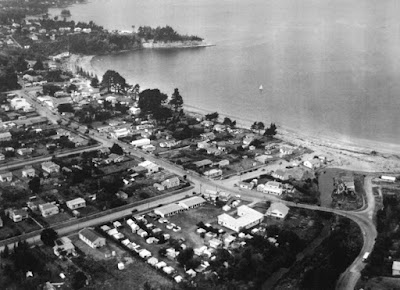
Below - military housing disguised as NZ State Houses:

The gun emplacements and observation post were similarly heavily disguised - their roofs of reinforced concrete had false ones of wood and tile constructed on top - so they resembled civilian housing. They were also painted in pastel civilian colours as opposed to drab military ones. The observation slits of the observation post were disguised by the painting of false windows, while the gun emplacements were further camouflaged - with canvas netting hung from the false roofs and painted to resemble the walls of a house: complete with doors and windows.This domestic deception was completed with fencing around the emplacements to simulate vegetable gardens. Finally, the underground reservoir was disguised by simply painting the concrete black and outlining it in white - to resemble a tennis court.
Below- camouflaged gun emplacements:


In May 1942 radar was installed at a site 1.5 miles (2.4km) west of the battery. The 63rd Battery was fully manned at the height of concern over an anticipated Japanese invasion in 1942, but by early 1944 had been placed into reserve as the larger battery at Whangaparaoa had been completed and the minefields finally laid.
After the war the area was used mainly as a store area for surplus army equipment, then for training purposes. Annual camps for trainees were held each year and live firing exercises were carried out. In 1952 the 6in guns were replaced by 3.7-inch anti-aircraft guns, which involved considerable modification to the emplacements. The 3.7-inch guns were removed in 1956, and the area was again used as a store for surplus army equipment until the site was declared redundant and disposed of.The military housing was converted into a rental housing development under the State Advances Corporation (Housing New Zealand).
The main cliff-top battery area was ceded to the Takapuna Borough Council in the 1960’s and renamed John F Kennedy Park to mark the memory of the assassinated US President. Later, in 1984, the land area was gazetted as a Recreation Reserve.


Comments
Post a Comment