Long Bay
The area now known as Long Bay was inhabited by Maori for several hundred years, and there remains evidence, although scant) of their occupation in the form of earthworks and middens. North Shore residents may recall the discovery of human bone material some years ago when the cafe by the amenities block was to be rebuilt.
This was regarded as desecration and the project was abandoned.
In Maori times all of the settlements along eastern coast from Northland to Auckland were likely to have been subject to raids and counter-raids by opposing tribes. The most devastating attacks being during the Musket Wars when Nga Phui swept down obliterating many traditional pa with their firepower and hunger.
The pioneer histories of Torbay and adjacent Long Bay are somewhat intertwined as pioneer farms often encompassed areas of each locality.
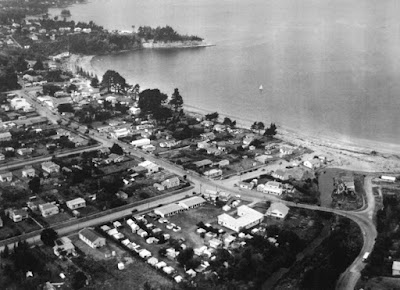
Below - Long Bay as a popular camping ground in 1951 WA-26207-F:

It appears that the original European owner of the area encompassingTorbay and Long Bay was John Logan Campbell (later “Sir”, and known as “The Father of Auckland”), who also originally owned seaside land from the vicinity of Campbells Bay perhaps as far northwards as Okura.
Mr Campbell sold the land at what became “Long Bay” to a Mr Alfred Long - little appears to be known of him or his farming activities. However, it is of record that he sold 700 acres to Alexander Pannhill and family in the early 1860’s. The tract was bordered to the south by what is now Glenvar Road, extending north to mid-way up Long Bay - land to the north by then owned by the Vaughans.
Development of the budding farm by the Pannhills continued, but was interrupted by the unfortunate death of their eldest son from blood poisoning in 1867, after which his father Alexander lost heart and in 1869 sold the land back to Mr Long - at a loss.
Inter-racial friction resulting in the start of the Waikato invasion in July 1863 by Gov Grey had pioneer families on alert for trouble, and there were several (fortunately unwarranted) scares when unknown Maori passed through the area. It would appear that the remaining local Maori were more interested in the purchases that could be made with money that could be made from gum-digging than attacking the suppliers of material and edible goods.
The most well-known, and indeed charasmatic, European personality was undoubtably Charles Chomondley Smith whose business interests grew to encompass both Long Bay and Torbay.
[See: https://www.wikitree.com/wiki/Smith-146679
Born in Australia in 1834 he came to Auckland with his mother and sister after the death of his father. With preparations well under way for the invasion of the Waikato at that time there was plenty of opportunity in the military. Mr Smith joined the First Infantry Battalion under Captain Wynyard (Wynyard Point). In 1858 he was promoted to a command in the cavalry and given the task of protecting the Eastern Bays from Narrow Neck to the Wade River. As an expert swordsman and fluent in Maori he soon gained the mutual respect of local chiefs.
1859 saw Mr Smith back in civilian life - whereupon he leased property at the northern end of Long Bay from a Mr Lyes. Unfortunately his sheep-rearing venture failed when scab killed most of his flock. Undeterred, he took to teaching and by 1873 was headmaster of Remuera Public School. Other posts followed until the Smith family returned to the Glenvar hills which overlook Long Bay, to purchase what became “Glenvar Estate” from Mr Lyes.
Ever the entrepeneur, Charles Chomondley Smith had some success with growing tobacco, but prices fell below sustainable levels. Next came the Glenvar Wine Company which enjoyed success for many years.
Meanwhile, the now-adult Smith sons operated a profitable flax mill at Torbay until the flax plants were all cut out. A timber mill followed - processing kauri from the Hauraki Gulf and the Coromandel, as well as pines from Mr Brown’s farm in Browns Bay. Eventually the supplies of kauri were also exhausted.
In 1863 the Vaughan family brought the lease and farmed the area until they sold it to the Auckland Resort Authority in the late 1960s.The beachfront area is now Long Bay regional Park and at the northern end is the historical Vaughn family homestead - now a museum.
“Early History of East Coast Bays” compiled by Jenny Willis
“A Long History into Long Bay” from Auckland Transport
“The North Shore, an Illustrated History” by Davis Verran
Charles and Sarah Smith produced thirteen surviving children - most whom
stayed locally, married, and produced more offspring. Sarah passed in
1928 aged 89, while Charles reached 101 in 1935 - and undoubtably
received a congratulatory telegram from the King.
The name
Chomondeley was not part of Charles’, surname, but an aunt’s married
name - he was christened Charles Ross Chomondeley Smith. The
“Chomondeley” was later affixed to “Smith” and later the two hypenated
by some descendants into “Chomondeley-Smith”.
[“Chomondeley” is a
surname of English origin: and links the personal name of “Ceolmund”
with “leah” - a grove. Thus Ceolmund’s Grove”. The family is ancient,
with many distinguished ancestors].


Comments
Post a Comment