Milford
At the beginning of the 20th century Wairau Creek was the roadway into Milford for bulky and heavy commodities such as building materials. Sailing scows from Auckland with their cargoes entered the creek to be towed up to the pool by their crews and Maori in rowing boats to what was then called Sheriff's Bridge. The vessels were unloaded and often reloaded with firewood to return with the ebbing tide.

By the 1920s Milford was beginning to develop and they were plans to construct a mooring area in the creek for pleasure boats. However these plans came to nothing. At the same time the Bridgeway picture theatre was built on the bank of the creek - powered by electricity generated by a water wheel. This venture also did not prove successful, but traces of this ill-found venture may still be seen.
In 1926 the Milford surf lifesaving club was formed, the first in Auckland.
In the late 1920s the Milford swimming pool was also built and became
extremely popular. (However because of the mud bottom it was later
considered to be a health hazard, and was closed down on the order of
the health department).
To further attract and entertain visitors to the area the old Pirate Shippe was built in 1927 by the then fledgling Fletcher construction company. The vessel was a copy of a Spanish galleon.


Until the late 1950s when the structure was demolished, the Pirate Ship with its tea rooms, dining, dances and entertainment had been a drawcard for people from all over Auckland for decades. People dressed to the nines to attend the many functions - it was here that people socialised, courted, and conducted business deals. The passing of the Pirate Ship saw the end of an era, while the opening of the Auckland Harbour Bridge on 30 May 1959 heralded the beginning of another.
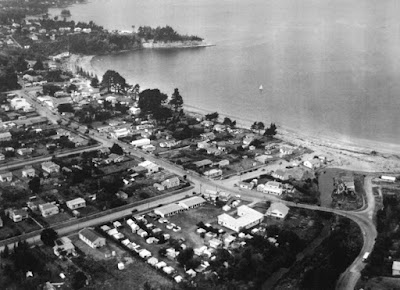
Framed copies of these and other Milford and North Shore photographs are available from my weekly stall at the Sunday market in Browns Bay.


Comments
Post a Comment